I've broken my 2012 goals into 4 categories for reflection: Organization and Sharing, Research, Career and Education, and Real Life and Relationships. I completed 3 of 6 goals--and if you count the addition of the 4th category then 4 of 7. My goal progress was balanced well across all categories. I hope to make a list for 2013 soon. What are/were your goals?
Update: After writing this, I noticed it was my 100th post. That is a fun accomplishment that came as a surprise. I'd categorize the blog under Teaching and Sharing I think--a category I did not include.
Organization and Sharing
1. Name 10% of my 25,000+ genealogy files ☑
I reached my goal through a combination of Tidy Up for MAC and organizational naming. Using Tidy Up, I was able to identify the duplicate images in file and delete them in a matter of minutes. That task was something that I expected to take many hours before finding that software.
Although I added several more files to my genealogy file, I ended up with less than 21,000.
I also switched from using a 64GB USB drive to using Dropbox as my primary backup and portability solution. FamilySearch (here) and Eastman's Online Genealogy Blog (here, but I am having trouble with the link) give good reviews of this service as it might relate to genealogy. Having all my files synced instantly makes my organizational naming project possible to do from any place with an Internet connection too.
2. Transcribe 200 pages of family letters ☐
This is something that I didn't focus on at all in 2012, but will likely move to my 2013 list as a worthwhile goal.
Research
3. Go back at least one additional generation on 5 distinct
end-of-line ancestors ☑
This goal was completed first, within 3 months. Those first 3 months of 2012 seemed almost made for this. I had extra time and spent a few days a week a few times in the Family History Library.
Career and Education
4. Excel in a new full-time genealogy related career ☑
From March to June I had a 3 month internship with FamilySearch--it was a dream come true. For the past 3 months I have been working in my 'new full-time genealogy related career' at HEREDIUM Probate Research LLC.
5. Become an AG through ICAPGen ☐
This goal is surely worth the effort, but I set it aside to focus on more immediate goals 4 and 7. Especially 7, as I could have focused a little less on my college town social life earlier this year. :)
6. Begin a Masters program in genealogy ☐
This goal is surely worth the effort, but I set it aside to focus on more immediate goals 4 and 7. This program started in October right when my new career was demanding extra focus to get things rolling. I am considering moving this to 2013, though other life goals are competing for attention.
Real Life and Relationships
[7.] I married the woman of my dreams. We spent part of our honeymoon trip in Mexico visiting her family members, asking questions, visiting family lots in cemeteries, and gathering old family photos. Besides that, we've been working on her tree. A long lost cousin got in touch with us and added some more information. We ran into another one of her relatives while on a religious trip to the Hermosillo temple. Before all that, while we were still dating I was able to help her find her great grandfather's baptism record with his grandparents' names. Of course, I had a lot of other real life successes that I haven't been able to connect to genealogy yet.

Showing posts with label Inspirational. Show all posts
Showing posts with label Inspirational. Show all posts
01 January 2013


18 November 2012
Amend Process of Elimination
.jpg) |
| a different duo - John Philip with his son Charles P. Ament |
On November 1st, All Saints' Day, I toured the hometown of my immigrant ancestors--son and father duo--John Philip Ament and Johann Georg Amend (also Ament, Amendt, Am Endt). They arrived in the USA between 1835 and 1840. Using online records and the microfilms I had already confirmed this line two additional generations: Johannes Amend b.1771 and Johannes Amend b.unknown.
In my previous Amend blog post I mentioned "
08 November 2012
The National Archives of Ireland's free genealogy website by FamilySearch

I have a couple elusive Irish ancestors of my own so I headed over to the site for a test ride. There is not enough material at this time to solve my mysteries, but the material is ground-breaking nonetheless. The 1901, and 1911 Irish census, are available alongside the tithe applotment books, and soldier's wills 1914-1917. Although some of these records were available elsewhere online, there are two benefits for the researcher.
- the records are free
- they include images of the original documents
"The Tithe Applotment Books are the first in a series of National Archives records of genealogical interest to be digitised by the Genealogical Society of Utah in partnership with the National Archives, and placed online free to access. Others will follow over the coming years; the next will be the Calendars of Wills and Administrations, 1858 - 1922."
For those of you who do not know, the Genealogical Society of Utah is FamilySearch which is sponsored by the Church of Jesus Christ of Latter-day Saints. I'm excited the most about this partnership because I see this as one step by FamilySearch in making records freely available to everyone. A process that continues to hasten as new partnerships are secured. We all benefit, especially the archives who long to preserve and make available their precious holdings.
01 November 2012


04 January 2012
01 January 2012
2012 Family History Resolutions
Every year I see many genealogy miracles. I solve multiple end-of-line problems, progress in my own skills by leaps and bounds, and contribute to the family history community in important ways.
This year I've decided to go with the trend among other GeneaBloggers and write some goals so that you--my readers--can hold me accountable, and perhaps I will accomplish a few of the goals that I usually set on the back burner.
This year I've decided to go with the trend among other GeneaBloggers and write some goals so that you--my readers--can hold me accountable, and perhaps I will accomplish a few of the goals that I usually set on the back burner.
- Name 10% of my 25,046 ambiguous genealogy files (pictures, historic documents, scanned genealogy charts, letters etc.) using the "Surname, Given Name(s) - Title (Optional Short Description) Year" format. Example: McCormick, Michael W - Diploma 2011; Some of my files have searchable names while other files still have consecutive numbering that was assigned by digital camera data or date scanned information. While scanning is the more essential step, I hope to get the files organized before I turn 120 or the world ends in December. I'm hoping the world doesn't end.
- Transcribe 200 pages of family letters; Many of the letters that came into our possession have never been read by anyone in my immediate family and are still in original paper form or scanned only. Transcribing will give me a good motivation to read them and will make it easier for others to Control+F (search) for data in the future.
- Go back at least one additional generation/individual on 5 distinct end-of-line ancestors; this should be the easiest goal as I can't imagine wanting to do anything else more.
- Excel in a new full-time genealogy related career; While I've been working in the field since 2007, I graduated with a Bachelors of Science last month and moved to Provo to start a new career there.
- Become an AG through ICAPGen; I'm within 70 hours of the application hour requirements--while I am well over the total hourly requirement, I lacked sufficient experience in one of the sub-regions. I'm partly through the four generation project.
- Begin a Masters program in genealogy; I recently applied for the October 2012 postgraduate certificate program with University of Strathclyde.
19 December 2011
Amendt Genealogy Miracle
1 Nov 2011, while a BYU-Idaho student - This morning I had a genealogy miracle. I knew that I had a lot to do for the college courses I was taking in this my last semester, but I also knew that my ancestors wanted to be found. I felt impressed to go to the Family History Center on campus. About a week ago I ordered a microfilm of a German Kirchenbuch (Church Book/Register) for Heuchelheim, Germany on which I knew the Amendt* family would appear. When I got to the center I put the microfilm on the reader and began to look through the German script from the early 1800s. Even after taking a class in German genealogy research, reading the film was difficult. Miracles often come through the people around us and that morning, a family history missionary with a specialty in German research--Sister Hart--was helping run the center. She helped me find the baptism record of my 3rd-great grandfather Philipp Amend (known as John Philip Ament after his emigration). This kind sister missionary even served part of an earlier mission near the area where these ancestors of mine were from. Running low on time, and trying to be as appreciative as possible, I asked her if she might create a transcript and translation for me. I needed to go to class.
The sister missionary kindly helped me read the record and even did a partial transcription and translation which I picked up about a week later. She went above and beyond by finding--on FamilySearch.org--two of my 3rd-great grandfather's siblings whose names my family was missing. They died young and when John Philip emigrated, over time the family's memory of those children was lost. I spent some more time going through the microfilm on my own with the aid of the transcription Sister Hart provided. I copied the originals of those two siblings' baptisms and several more records--including marriages and deaths--on 2 or 3 visits over the next couple weeks.
Throughout the experience I called my parents to explain what I was finding. With the encouragement of my mother, when I got what I could from the years covered by that microfilm, I ordered the next film. My parents were coming to my graduation the weekend of the 16-17th of December and offered to help look through the records when they arrived. After ordering the film I got a notice that it was on backorder and was concerned that we might not get to look at it before I had to move out on the 17th. Friday the 16th my parents and I showed up at the family history center to ask if it came in. I had not received the customary e-mail notification because the data entry missionary had not been in recently. The missionaries who were there looked through the unprocessed films and found that which I had ordered. I showed my parents how to recognize the records and they went on to copy several more protestant church records for our Amendt ancestors.
The right person happened to be there at the right time to help me on November 1st, I found many original records and some previously missing family members, improved my German research skills through practice, and enjoyed some family time looking through the film which barely arrived in time for us to review before I moved out the next day. These small and simple things witness the hand of the Lord in helping us learn about our heritage and finding our connection to the eternal family.
NOTE: This post explains part of the events which helped me know which microfilm I needed to order. With so much on my plate, it took me a couple months before I decided to order the film.
*Amendt surname also spelled as Amend or Ament.
The sister missionary kindly helped me read the record and even did a partial transcription and translation which I picked up about a week later. She went above and beyond by finding--on FamilySearch.org--two of my 3rd-great grandfather's siblings whose names my family was missing. They died young and when John Philip emigrated, over time the family's memory of those children was lost. I spent some more time going through the microfilm on my own with the aid of the transcription Sister Hart provided. I copied the originals of those two siblings' baptisms and several more records--including marriages and deaths--on 2 or 3 visits over the next couple weeks.
Throughout the experience I called my parents to explain what I was finding. With the encouragement of my mother, when I got what I could from the years covered by that microfilm, I ordered the next film. My parents were coming to my graduation the weekend of the 16-17th of December and offered to help look through the records when they arrived. After ordering the film I got a notice that it was on backorder and was concerned that we might not get to look at it before I had to move out on the 17th. Friday the 16th my parents and I showed up at the family history center to ask if it came in. I had not received the customary e-mail notification because the data entry missionary had not been in recently. The missionaries who were there looked through the unprocessed films and found that which I had ordered. I showed my parents how to recognize the records and they went on to copy several more protestant church records for our Amendt ancestors.
The right person happened to be there at the right time to help me on November 1st, I found many original records and some previously missing family members, improved my German research skills through practice, and enjoyed some family time looking through the film which barely arrived in time for us to review before I moved out the next day. These small and simple things witness the hand of the Lord in helping us learn about our heritage and finding our connection to the eternal family.
NOTE: This post explains part of the events which helped me know which microfilm I needed to order. With so much on my plate, it took me a couple months before I decided to order the film.
*Amendt surname also spelled as Amend or Ament.
22 August 2011
Why I Like Visiting Graves
 One of my favorite things in genealogy is to visit the grave sites of my ancestors. There is a special sacredness about being at the final resting place of an ancestor, not to mention it is refreshing to do genealogy outside now and then. Finding these grave sites represents a recurring theme among the family history miracles I've experienced. I recall how several years ago, in 2005, my family visited the Mt. Carmel Cemetery on O'Donnell St. in Baltimore. My father, mother, and I, split up to find the location of George and Margaret Grauling's, my 3rd-great grandparents', grave. My mother was the first one to spot it and she hollered excitedly for us to come over to see it. I know that was one of the most meaningful cemetery finds for her. Finding a grave site for the first time is exciting. The search often includes fun "detective" work, but sometimes it just takes a relaxing stroll through the cemetery. Honoring our ancestors by visiting their graves has been a bonding experience for our family. Over the years, we have visited the graves of close to 50 direct ancestors as well as countless others. With the assistance of Find A Grave volunteers and others, our family has access to pictures of another 20 or so direct ancestors' graves.
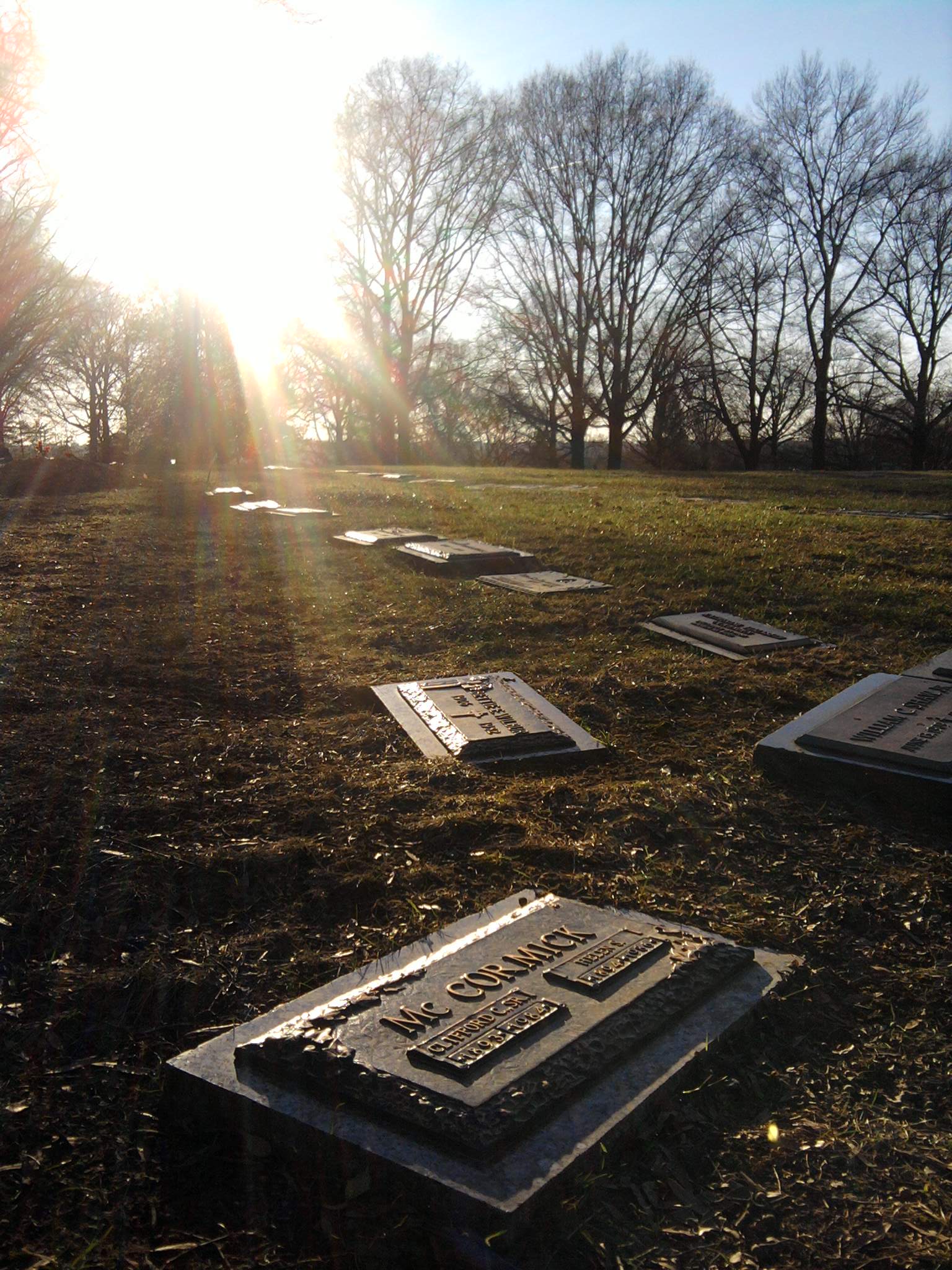 On that same trip my parents and I stopped at the Rock Creek Cemetery to find my great grandparents' grave--Clifford and Helen McCormick. We did not find them at that time because the cemetery office was closed, but I went back a couple months later after getting the section number by calling. What happened next is exemplary of other discovery experiences I've had. After parking on a cemetery road that bordered that section, I came out of my car and walked forward. The very first stone I came to was the stone of my great grandparents and the light from the sun seemed to shine down directly on that very spot during that beautiful pre-Spring day in March 2010. For several minutes I stood there and took in the calm of the day and felt thankful for my great grandparents.
Finding my 5th Great-Grandfather
NOTE: This post has been formatted, edited, and updated, for easier reading on this blog from an earlier article.
As any genealogist knows, there are a few experiences that one always looks back on with amazement which push that person forward in their never-ending search. For me, one of these experiences was finding my 5th great-grandfather, John Whipple.
Cordelia Whipple
At a young age, I became curious about my genealogy.
I was excited to look at the genealogy chart my grandparents gave to my parents. It was written by hand with various circles, lines and marks connecting what seemed like a “treasure” map.
Soon I noticed the name Cordelia Whipple. This was my grandmother's grandmother and the line stopped there. “Why didn't we know more about her family?,” I wondered. Grandmother told me a few stories about the Whipple family, but it wasn't much. She never knew her grandmother.
Grandmother said that Cordelia had complications resulting from the birth of her second child, and Cordelia died soon after. This knowledge proved most useful in taking the next research step because it provided us with a death date.
The other two stories do not appear to be important, but they kept my curiosity alive. It was said that my Whipple family is related to William Whipple of the Declaration of Independence. Another rumor was that Cordelia's parents disowned her at her marriage to the poor German, Charles Ament.
Until I had some real evidence, those stories drifted around in my mind as my only perception of Cordelia's ancestors. I could never find evidence for either of those claims [except this poem] and I felt a little short changed to know so little.
I was just getting into genealogy back then. Most of my first substantial research consisted of trips to the Maryland Hall of Records or to cemeteries in Baltimore, to find my mother's ancestors. This was one of my first major efforts to research my father's side.
The Search Begins
While I was preparing to end my freshman year at college, I questioned whether I should come home for an extended break or stay there. I felt like the decision was an important one and I prayed to know what to do. No immediate answer came, but I began to feel a spiritual impression that, if I went home, the next year would be a good year for family history. The story of the Whipple research is only one example of how my family was blessed in family history as a result of my choice to spend the next several months at home. I thank my parents for their support which made it possible.
In mid-2005, the Whipple family was on my mind. With my additional experience in genealogy research, I planned to go to New York and look at the death indexes.
I wrote about the trip in my journal: "My parents, brother. . .and I are in NY. . . Today we research family. 9am, when the Rochester Library opened we went in. My mom worked in the Local History/Genealogy room while dad looked at old microfilmed Rochester papers and I used the NY State Vital Records Index."
- 22 April 2005
I still remember looking at the microfiche and seeing "Delia W. Ament, February 21, 1892." I expected to see the name Cordelia and it was under the name Cordelia that I had always previously looked for her on census records. I knew I was on to something so I ordered the death certificate and waited.
Miraculous Timing
After a run of intense success, there is a time of perseverance when one simply must plug on with the work. This was the case for the next two weeks. On returning from the Washington, D.C. Temple, my parents and I found that the transcript of Cordelia Whipple's death register entry was in our mail box. I took it as a sign that putting God first brings blessings. I also believe that knowing more about our ancestors is part of God's plan. Small things witness God's hand in our lives and I can't help but be grateful.
John A. Whipple
The certificate revealed that Cordelia was born in Nelson, New York, and her father's name was, John Whipple. Armed with those facts, I was able to find “Delia Whipple” on the 1860 census in Fenner, New York--a small town nearby Nelson. For almost three months I went through several sources, corresponded with Whipple researchers and experienced even more miracles.
One of the sources I discovered was John A. Whipple's pension record. I ordered the record through the National Archives website after finding him on an online index. I always wanted to find a Civil War story in my family. Now I had one.
John died when Cordelia was only four years old and Cordelia was raised by her mother, Jane, and stepfather Francis Cary. Then when Cordelia died, eight days after her second child was born, much of her family history was not passed on.
From 3rd to 5th Great
In looking at the 1860 census, I saw Elisha Whipple lived next to John and Jane. I realized that Elisha could be John A.'s father. One of the Whipple researchers I was e-mailing shared part of a local history about the Whipple family. It misnamed Elisha as John, but all the right people were there—Elisha's son John as well as his wife Lucy Dryer.
In the local history we read that Elisha's father was John also. They were a prominent family in a small town. There was a transcription on the Internet of John Whipple and Jerusha Inman's grave stones in Fenner. Because of that among other things, I was able to pinpoint them as my 5th great-grandparents. I will always be grateful to Dan Weiskotten who took the time to transcribe and map out every little cemetery in that area. [I just realized that he died during the months that I was doing this research.] Several of my ancestors were found due to his foresight. I never would have known that my 5th great-grandparent's stones were in the middle of a corn field.
John, Where are You?
 In July 2005, my parents and I were near Fenner on the way home from a business trip. Not willing to pass up the opportunity, we decided to visit the grave of John and Jerusha. Even though Weiskotten's directions were detailed, we knew it would not be easy as we looked into the field of corn before us. We spoke with a nice elderly lady who lived near the field. She sent us down the correct row with a warning much like, “Things are overgrown back there.” With faith my parents and I proceeded along the path next to the field. We walked all the way to the end, pausing in places and began to wonder out loud if we were going to find it at all. The entire row seemed to be covered in weeds. Contemplating the necessity of concluding our search, we walked part of the way back. Then we paused, determined to find John and Jerusha. I closed my eyes and said a prayer. When I opened my eyes, the top of the stones were visible right in front of us.

Additional Research Notes
At this time, little is known of the family and none of the compiled genealogies that include this John Whipple are able to provide good sources for his parentage. Many un-sourced online pedigrees claim his father as Nathaniel Whipple.
John Whipple came from Rhode Island1 previous to the 1810 census enumeration. On that census he lived near A. Inman, presumably a relative of his wife, Jerusha Inman.
1. 1850 United States Federal Census, microfilm or on-line database, National Archives and Records Administration, 700 Pennsylvania Avenue, NW, Washington, DC 20408-0001 , M432. 1,009 rolls of microfilm. Available also through the FHL and on-line databases like http://www.ancestry.com/
As any genealogist knows, there are a few experiences that one always looks back on with amazement which push that person forward in their never-ending search. For me, one of these experiences was finding my 5th great-grandfather, John Whipple.
Cordelia Whipple
At a young age, I became curious about my genealogy.
I was excited to look at the genealogy chart my grandparents gave to my parents. It was written by hand with various circles, lines and marks connecting what seemed like a “treasure” map.
 |
| Cordelia Whipple |
Grandmother said that Cordelia had complications resulting from the birth of her second child, and Cordelia died soon after. This knowledge proved most useful in taking the next research step because it provided us with a death date.
The other two stories do not appear to be important, but they kept my curiosity alive. It was said that my Whipple family is related to William Whipple of the Declaration of Independence. Another rumor was that Cordelia's parents disowned her at her marriage to the poor German, Charles Ament.
Until I had some real evidence, those stories drifted around in my mind as my only perception of Cordelia's ancestors. I could never find evidence for either of those claims [except this poem] and I felt a little short changed to know so little.
I was just getting into genealogy back then. Most of my first substantial research consisted of trips to the Maryland Hall of Records or to cemeteries in Baltimore, to find my mother's ancestors. This was one of my first major efforts to research my father's side.
The Search Begins
While I was preparing to end my freshman year at college, I questioned whether I should come home for an extended break or stay there. I felt like the decision was an important one and I prayed to know what to do. No immediate answer came, but I began to feel a spiritual impression that, if I went home, the next year would be a good year for family history. The story of the Whipple research is only one example of how my family was blessed in family history as a result of my choice to spend the next several months at home. I thank my parents for their support which made it possible.
In mid-2005, the Whipple family was on my mind. With my additional experience in genealogy research, I planned to go to New York and look at the death indexes.
I wrote about the trip in my journal: "My parents, brother. . .and I are in NY. . . Today we research family. 9am, when the Rochester Library opened we went in. My mom worked in the Local History/Genealogy room while dad looked at old microfilmed Rochester papers and I used the NY State Vital Records Index."
- 22 April 2005
I still remember looking at the microfiche and seeing "Delia W. Ament, February 21, 1892." I expected to see the name Cordelia and it was under the name Cordelia that I had always previously looked for her on census records. I knew I was on to something so I ordered the death certificate and waited.
Miraculous Timing
After a run of intense success, there is a time of perseverance when one simply must plug on with the work. This was the case for the next two weeks. On returning from the Washington, D.C. Temple, my parents and I found that the transcript of Cordelia Whipple's death register entry was in our mail box. I took it as a sign that putting God first brings blessings. I also believe that knowing more about our ancestors is part of God's plan. Small things witness God's hand in our lives and I can't help but be grateful.
John A. Whipple
The certificate revealed that Cordelia was born in Nelson, New York, and her father's name was, John Whipple. Armed with those facts, I was able to find “Delia Whipple” on the 1860 census in Fenner, New York--a small town nearby Nelson. For almost three months I went through several sources, corresponded with Whipple researchers and experienced even more miracles.
|
| Soldiers Home National Cemetery, Washington D.C. |
John died when Cordelia was only four years old and Cordelia was raised by her mother, Jane, and stepfather Francis Cary. Then when Cordelia died, eight days after her second child was born, much of her family history was not passed on.
From 3rd to 5th Great
In looking at the 1860 census, I saw Elisha Whipple lived next to John and Jane. I realized that Elisha could be John A.'s father. One of the Whipple researchers I was e-mailing shared part of a local history about the Whipple family. It misnamed Elisha as John, but all the right people were there—Elisha's son John as well as his wife Lucy Dryer.
In the local history we read that Elisha's father was John also. They were a prominent family in a small town. There was a transcription on the Internet of John Whipple and Jerusha Inman's grave stones in Fenner. Because of that among other things, I was able to pinpoint them as my 5th great-grandparents. I will always be grateful to Dan Weiskotten who took the time to transcribe and map out every little cemetery in that area. [I just realized that he died during the months that I was doing this research.] Several of my ancestors were found due to his foresight. I never would have known that my 5th great-grandparent's stones were in the middle of a corn field.
John, Where are You?


Additional Research Notes
At this time, little is known of the family and none of the compiled genealogies that include this John Whipple are able to provide good sources for his parentage. Many un-sourced online pedigrees claim his father as Nathaniel Whipple.
John Whipple came from Rhode Island1 previous to the 1810 census enumeration. On that census he lived near A. Inman, presumably a relative of his wife, Jerusha Inman.
1. 1850 United States Federal Census, microfilm or on-line database, National Archives and Records Administration, 700 Pennsylvania Avenue, NW, Washington, DC 20408-0001 , M432. 1,009 rolls of microfilm. Available also through the FHL and on-line databases like http://www.ancestry.com/
Spiritually in Tune - Blasius Grein
A couple of months ago I was in Idaho at the David O. McKay Library, in the middle of a semester at college, when I felt a distinct impression to go to FamilySearch.org and look for my 4th-great grandfather, Blasius Grein. What made the experience even more memorable was that I had not yet begun studying for the day. I was sitting there, reading the scriptures and listening to some christian choir music to prepare my mind. Though the feeling to look for Blasius was specific and out of the blue, I recognized the event as part of a pattern of revelation that I have received throughout my life.
Long story short, I looked for Blasius, and within a couple of days I had all his ancestors going two more generations back, with some lines going as many as five generations more than I previously had. There have been times in the past few years that I wondered how my research could ever be as miraculous and spiritually charged as it was in 2005. That year was amazing for my research. My concern that it never could be that good again has been continuously proven wrong. The miracles just keep coming.
Long story short, I looked for Blasius, and within a couple of days I had all his ancestors going two more generations back, with some lines going as many as five generations more than I previously had. There have been times in the past few years that I wondered how my research could ever be as miraculous and spiritually charged as it was in 2005. That year was amazing for my research. My concern that it never could be that good again has been continuously proven wrong. The miracles just keep coming.
21 August 2011
Waiting for a Genealogy Miracle...
Sometimes reading a book like The Family Tree Problem Solver: Proven methods... will give me new ideas to break through my brick walls. Sometimes the solutions will come to me while I am taking a genealogy class from an institution of higher learning. Sometimes it requires consulting with someone else who can give the problem their fresh perspective.
If you really want to solve a problem keep that family on your mind all the time. Ideas will come to you. Be willing to try new approaches and go the extra mile. It is okay to switch your focus to another line for awhile, but let your mind wonder back to your brick wall often.
There is a principle in family history work that is not generally taught, but to me it rings the most true. That principle is faith. Faith is believing in something that you can't see, but is still there. I can't see it, but sincerely feel I am going to solve all my "brick walls" someday. Faith takes action. I have to do everything within my power to find my ancestors. Faith takes patience. I have hired a professional, taken a college course on Irish genealogy, watched a few webinars, read a well known book on the subject, and done everything I learned plus some, without being able to go past my Irish 4th-great grandfather, Charles McCormick. Patience requires that I do not give up. It requires that I continue on a path of learning my whole life.
Balance is another important principle of genealogy research that seems to be more assumed than taught. I could drop all my other goals, move to Ireland and spend the rest of my life looking at all the historic records that exist. That is an unreasonable choice for me. Good genealogy research requires balance. After all, Charles McCormick is not the only ancestor who deserves my attention.
Keeping that in mind, I wholeheartedly believe in genealogy miracles. Last Monday, the 15th, one of those miracle happened. Actually, they happen all the time.
Hesse-Darmstadt
If you really want to solve a problem keep that family on your mind all the time. Ideas will come to you. Be willing to try new approaches and go the extra mile. It is okay to switch your focus to another line for awhile, but let your mind wonder back to your brick wall often.
There is a principle in family history work that is not generally taught, but to me it rings the most true. That principle is faith. Faith is believing in something that you can't see, but is still there. I can't see it, but sincerely feel I am going to solve all my "brick walls" someday. Faith takes action. I have to do everything within my power to find my ancestors. Faith takes patience. I have hired a professional, taken a college course on Irish genealogy, watched a few webinars, read a well known book on the subject, and done everything I learned plus some, without being able to go past my Irish 4th-great grandfather, Charles McCormick. Patience requires that I do not give up. It requires that I continue on a path of learning my whole life.
Balance is another important principle of genealogy research that seems to be more assumed than taught. I could drop all my other goals, move to Ireland and spend the rest of my life looking at all the historic records that exist. That is an unreasonable choice for me. Good genealogy research requires balance. After all, Charles McCormick is not the only ancestor who deserves my attention.
Keeping that in mind, I wholeheartedly believe in genealogy miracles. Last Monday, the 15th, one of those miracle happened. Actually, they happen all the time.
Hesse-Darmstadt
18 August 2011
The Church of Jesus Christ of Latter-day Saints Promotes Family History
Many genealogy enthusiasts are aware that the largest genealogy organization in the world--FamilySearch--is owned by The Church of Jesus Christ of Latter-day Saints. Have you ever wondered why?
I received a notice today about updates to the family history initiative of The Church of Jesus Christ of Latter-day Saints [LDS]. More direction is being given to the younger generation of missionaries regarding family history and genealogy work. LDS missionaries as young as 19 are sent to locations determined by revelation through church leadership. Generally these young missionaries are known for their proselyting and service to the community. Those leaving on missions will now watch training videos which encourage them to talk about family history with those whom they share the gospel with. From 2005-2007 I served such a mission in Virginia and had the opportunity to participate in a pilot program called "The Gift of Family History." Family history enthusiasts within the LDS Church have long recognized the spiritual connections that family history helps to develop within individuals and families. Many individuals of other faiths likewise recognize a certain spirituality about family history research. Within the LDS Church I personally have learned to see the spirituality of family history from many different directions.
Family history teaches us that we are children of God.
When you start to get involved with family history, and progress backwards through the generations, your view of time changes. You begin to see that the 1800's, 1700's, 1600's... really weren't so many generations ago. You might think about how you know your parents or grandparents. They may have known their grandparents. Already from the memory of living people you may have jumped back into a world which you previously felt only existed in history books. While you are doing the hard work that it so often takes to prove your family line, you begin to feel a connection to your ancestors. When you serve people, you learn to love them. You've spent hours trying to find an ancestor so that they are not forgotten and somehow remembering them makes you feel as though your time on earth is more worthwhile. These feelings are not mistakes, they are not coincidences. God, our Father in Heaven, has set in motion a plan by which all his children can be remembered. In the Bible we read: "And he shall aturn the bheart of the cfathers to the dchildren, and the heart of the echildren to their fathers..." Malachi 4:6. Christianity is about love, Christianity is about service, Christianity is about family, Christianity is about eternity. Those who have gone on before us are just as real as we are.
I know that I have felt the blessings of family history in my life. Heavenly Father wants us to know we are his children and a Christ-centered effort to document our relationships going back to the time of our ancient forebears is all about that. I believe when we get to the other side we will have opportunities to complete our family pedigree charts all the way back to our Father in Heaven, but in the mean time it is the current of spirituality in the work of family history that makes the sometimes difficult work worthwhile.
I received a notice today about updates to the family history initiative of The Church of Jesus Christ of Latter-day Saints [LDS]. More direction is being given to the younger generation of missionaries regarding family history and genealogy work. LDS missionaries as young as 19 are sent to locations determined by revelation through church leadership. Generally these young missionaries are known for their proselyting and service to the community. Those leaving on missions will now watch training videos which encourage them to talk about family history with those whom they share the gospel with. From 2005-2007 I served such a mission in Virginia and had the opportunity to participate in a pilot program called "The Gift of Family History." Family history enthusiasts within the LDS Church have long recognized the spiritual connections that family history helps to develop within individuals and families. Many individuals of other faiths likewise recognize a certain spirituality about family history research. Within the LDS Church I personally have learned to see the spirituality of family history from many different directions.
Family history teaches us that we are children of God.
When you start to get involved with family history, and progress backwards through the generations, your view of time changes. You begin to see that the 1800's, 1700's, 1600's... really weren't so many generations ago. You might think about how you know your parents or grandparents. They may have known their grandparents. Already from the memory of living people you may have jumped back into a world which you previously felt only existed in history books. While you are doing the hard work that it so often takes to prove your family line, you begin to feel a connection to your ancestors. When you serve people, you learn to love them. You've spent hours trying to find an ancestor so that they are not forgotten and somehow remembering them makes you feel as though your time on earth is more worthwhile. These feelings are not mistakes, they are not coincidences. God, our Father in Heaven, has set in motion a plan by which all his children can be remembered. In the Bible we read: "And he shall aturn the bheart of the cfathers to the dchildren, and the heart of the echildren to their fathers..." Malachi 4:6. Christianity is about love, Christianity is about service, Christianity is about family, Christianity is about eternity. Those who have gone on before us are just as real as we are.
I know that I have felt the blessings of family history in my life. Heavenly Father wants us to know we are his children and a Christ-centered effort to document our relationships going back to the time of our ancient forebears is all about that. I believe when we get to the other side we will have opportunities to complete our family pedigree charts all the way back to our Father in Heaven, but in the mean time it is the current of spirituality in the work of family history that makes the sometimes difficult work worthwhile.
14 August 2011
Remember to Check FamilySearch... Again
My 2nd-great grandfather, Thomas Schilling, was on my mind after church today. He is my only 2nd-great grandparent whose parents are unknown. That is still the case after more than a decade of searching. I decided to say a prayer and start looking online. My main goal is proving who his parents are or finding a picture of him, but I have learned to find joy in every record found for an elusive ancestor.
After a few minutes of googling his name, I felt like I needed to go to FamilySearch.org and check for Maryland records that have been added since my last visit. I found a collection of Baltimore City probate records that had just been updated on 22 July 2011. I've been to the Maryland State Archives, where these records can be found, many times. The problem is that I always have so many records to look up when I'm there. I'm definitely thankful for the digitizing work of FamilySearch. Below I will include some screen shots from today's visit to FamilySearch.org.
I started looking at the list of Baltimore City probate records and when I picked a probate book to look at I was told to sign in. Though FamilySearch has allowed signed-in users to see more records than guests for some time, this is the first time I noticed the phrase "Sign in to view this image." There was a point that if you didn't know the value of signing-in that you simply would think there was no image available. I'm glad those days are gone.

Because this collection is not indexed by FamilySearch I had to go page by page, but it is okay. It was just like using the book index at the archive or courthouse. The only difference was that waiting for each page to load takes more patience than turning a page or cranking a microfilm. If you take note of the time on my task bar, you will see it took me quite some time. The good news is that, after feeling like giving up, I did find my ancestor Thomas Schilling.


This record hasn't answered my main question about Thomas, but it does lead me to a few other probate records such as his inventory. It is always interesting to see what goods an ancestor had and the value of each item. That is for another day.
There are three things I got out of this experience.
- Follow your inner call
- Find joy in every record found and
- Remember to Check FamilySearch... Again
09 August 2011
Finding John Whipple
Click here to load a 3 page inspirational PDF article giving my experiences researching my Whipple ancestry.
22 August, Update:
This article has been edited for better blog viewing and can be seen at this post:
Finding My 5th-Great Grandfather
22 August, Update:
This article has been edited for better blog viewing and can be seen at this post:
Finding My 5th-Great Grandfather
08 July 2010
FamilySearch expands holdings, ancestors found
After researching my family for more than a decade I am still finding things as FamilySearch expands their holdings. Recently at pilot.familysearch.org I found the entries for two of my direct ancestors in the NJ Death Certificates Index. Now I can get their certificates and for the first time, prove their parentage.
Stay up-to-date with updates to FamilySearch services on their Facebook page.
You can make more record available by indexing.
Stay up-to-date with updates to FamilySearch services on their Facebook page.
You can make more record available by indexing.
Subscribe to:
Posts (Atom)