Showing posts with label FamilySearch Indexing. Show all posts

04 October 2013

Introducing the New FamilySearch Indexing Tool, RootsTech 2014 preview

I've decided to write a few previews of stuff we will all learn about at RootsTech 2014. Earlier, I wrote about FamilySearch Obituaries. Another product coming next year at FamilySearch is an overhaul of the indexing tool, listed in the class schedule as: "Introducing the New FamilySearch Indexing Tool."

This is another one of my top pics for RootsTech 2014 classes to attend.
The RootsTech 2014 class list states: "Scott Flinders, the product manager responsible for FamilySearch indexing, will provide an overview and demonstration of the new, browser-based indexing tool being developed by FamilySearch."

Today (October 4, 2013), FamilySearch gave a presentation to Stake Indexing Directors which was available for viewing online. I've captured some screens and facts to provide you with this preview. If you don't want to know about this until RootsTech, I suggest you stop reading this.

As advertised before, the new system will be entirely browser-based so that downloading software is no longer required. Most of the basic workings of the system are still there, but everything has been enhanced in accordance with user feedback.

One of the first changes you'll notice, you will be able to use powerful filters and waypoint data to find a specific project to work on. You will be able to choose a specific town, county, or parish to work on, Flinders said.
The view of the actual work process provides all the tools we have come to know and love: Highlights, Lookup, International Characters, Handwriting Examples etc. Flinders pointed out that the traditional data entry modes are still there (table and form), and that two more are available. He said one was for indexers who like to index by column although I do not know how it differs from table mode. The 2nd new mode is "in-line" which will have you type the data in a box right where you see it on the screen, and move from one area to the next as you go. I'd like to try that.

The next thing I noted was Flinder's statement that "In addition to..." the current A/B/Arbitrate workflow, there will be a new A + Review workflow. At first I thought they were just doing a terminology change from arbitrator to reviewer, but it turns out that the new process will be entirely different. The reviewer will not compare 2 indexers' work, but will simply review the work of one indexer. Flinders stated that they believe the index quality will remain the same, and the output will rise 40-50%. Regarding the "in addition to" statement, he later clarified that the old system will be maintained and in use until they are able to migrate all users and stats to the new system. If the A + Review is successful, I think they will stop A/B/Arb when they close the old system, though this was not clear to me. This was perhaps the most exciting news to me because it means 40-50% more records for all of us! I would like to know what selecting "don't know" will do. For that matter, I'd like to know what happens if a reviewer says a data piece is wrong. It seems logical that wrong data be corrected by the reviewer, and "don't know" data get sent up the line to a more experienced reviewer, though nothing was said about that detail.

FamilySearch Indexing Groups are a major step forward as well. These groups come with better statistics reporting for group managers, group goals to motivate all users, an increased sense of "social media," among several other interesting features.
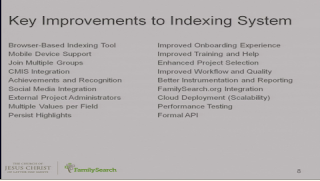


The list of improvements is impressive, although I must admit there are a couple which are over my head.

Further down, I've posted the slides that show the timetable for release.


And another thing is the new way to add indexing projects. Instead of requiring FamilySearch employees to add every new indexing project, specific volunteers can be approved to do this within the same website. Flinders mentioned that this will allow archives and other record custodians more control over adding their projects to the system, although I imagine FamilySearch will still require the images to be digitized and ingested according to their guidelines.


Phew! A lot of interesting facts and screenshots today. Come to think of it, I bet they'll be a lot more to learn by the time we get to RootsTech in February.

25 January 2013

RootsTech 2013: What might FamilySearch reveal?

Disclaimer: If you want to be surprised by everything FamilySearch announces at RootsTech 2013 don't read this post. I follow FamilySearch closely and will give my guesses as to some things they will "announce." In addition, I make no guarantee that these topics will be discussed.

I plan to update this post, so check back again before RootsTech 2013 to see if I have come up with any further guesses. Feel free to share any guesses of your own.

UPDATES:
February 1 - FamilySearch Photos new visibility on Family Tree
February 4 - Historic documents release goal brought forward
February 7 - Added a section of miscellaneous things in development
February 8 - Professional Genealogist pages by FamilySearch
                    BillionGraves reveals new must-see technology
  • FamilySearch Indexing
    • "Browser-based" Indexing
      • Introduced in concept FamilySearch Blog (August 2012) or before
      • Description: replaces current Indexing software, introduces indexing corrections
      • Mentions: complaints about indexing servers, and the lack of index correct-ability run rampant online
      • Goal release: second half 2013
      • Future: We will presumably no longer have indexing server errors as the experience will be built into the website and the images we use to index will be the same images we browse online. 
      • Concerns: I have some concerns about the indexing experience, such as whether filling multiple fields as quick as one can type, auto-fill options, rulers, handwriting guides etc. will still be possible? In addition, I wonder whether the website will be mobile capable. We will find out.
    • FamilySearch Linking
    • FamilySearch Indexing mobile app
  • FamilySearch Family Tree
    • FamilySearch Photos
      • Introduced about September 2012, after Kinfolio presumably discontinued
      • Description: This is a long awaited feature currently accepting photo uploads, which will eventually show up in Family Tree when that is turned on.
      • Mentions: Late in January 2013 this beta was advertised to LDS Family History Consultants. Before that it was already being shared to any members of FamilySearch's sponsor, who became aware of the special link. 
      • Goal release: a couple months, my guess is at RootsTech
        Photos now visible on Family Tree by those who are LDS and part of the beta.
      • Future: This will receive many minor upgrades like all FamilySearch systems, the stories feature will be improved. 
    • Upload historical records
      • Introduced: Concept discussed FamilySearch Feedback (June 2010), or earlier
      • Details: In the early stages of FamilySearch Photos it was thought that this was the system they'd use to allow users to attach historic documents. An early prototype had a documents tab. See Genealogy's Star Blog for a screenshot.
      • Mentions: ... Try searching document photos under the FamilySearch GetSatisfaction page for several informative posts.
      • Goal release: Some time in the next year we should hear more about attaching our own historical records, although it is not certain what tool will be used.
        "a few weeks away"
        as of 4 Feb 2013
      • Future: We have yet to see how this will play out, but it could fix two main needs. 1. attaching images of privately held single page source or copies
        2. uploading and indexing entire privately owned collectionsAlthough the introduction of browser-based indexing, or other tools, might make this possible... it is just as likely that the donation of entire collections will continue on a less automated path.
  • FamilySearch Books
    • Creating GEDCOMs from books
      • Introduced Feb 2012 by Annaleise Dearinger of FamilySearch Digital Books
      • Description: Renee's Genealogy Blog (February 2012)
      • Mentions: ...
      • Goal release: none
      • Future: It would be nice to see this tied into the FamilySearch Books experience, but I haven't heard anything since the first month or two of the project.
  • FamilySearch miscellaneous betas and concepts
    Because these are so early in concept and testing, there is little more that can be said.
    • Recording and sharing of audio interviews (image -->)
    • Canon Mark II records collections beta in which inside individuals are given this highly portable camera to digitize strategically important collections which are added to the website
    • Improved volunteer experience
    • Organizing a potential way for FamilySearch patrons to connect with genealogists
      February 8 - I became aware of the wiki pages for this purpose... something I missed before: https://www.familysearch.org/learn/wiki/en/FamilySearch_Wiki:WikiProject_Professional_Genealogists Will you add yourself?
    • Discussing ways to improve the collection donation experience, and possibly include individuals who are interested in donating a private collection
    • An ongoing effort to test new home page designs and improve user experience for FamilySearch.org (recent example)
    • Sharing data about living people (mentioned on GetSatisfaction by Ron Tanner, example)
      I wonder if this has any connection to the early Kinfolio beta and how it will--or will not--work with Family Tree.

09 March 2012

FamilySearch Linking Demo

Last month, at RootsTech 2012, FamilySearch demoed their new FamilySearch Linking software. This program allows volunteers to link the pre-FamilySearch-Indexing indices to digital images. FamilySearch has had volunteers indexing records since the 1960s or so, but only recently has come out with the ability to link the actual digital images to the records on their website. To clarify: the "linking" is automatic for anything that has been indexed since 2006 with the FamilySearch Indexing software, but image linking is now being done for the older indices. This linking software is expected to remain in pilot until the end of the year. I requested access from FamilySearch--which you can do as well by contacting support@familysearch.org.

Please watch this 5 minute demo of the new software and help spread the word. We will need a lot of volunteers to do all this work so that the images will show up on FamilySearch.org--and more people can find their ancestors for free.

Unable to display content. Adobe Flash is required.

14 August 2011

Remember to Check FamilySearch... Again

An inspirational post about research diligence and the constant expansion of FamilySearch's records collections.

My 2nd-great grandfather, Thomas Schilling, was on my mind after church today. He is my only 2nd-great grandparent whose parents are unknown. That is still the case after more than a decade of searching. I decided to say a prayer and start looking online. My main goal is proving who his parents are or finding a picture of him, but I have learned to find joy in every record found for an elusive ancestor.


After a few minutes of googling his name, I felt like I needed to go to FamilySearch.org and check for Maryland records that have been added since my last visit. I found a collection of Baltimore City probate records that had just been updated on 22 July 2011. I've been to the Maryland State Archives, where these records can be found, many times. The problem is that I always have so many records to look up when I'm there. I'm definitely thankful for the digitizing work of FamilySearch. Below I will include some screen shots from today's visit to FamilySearch.org.

I started looking at the list of Baltimore City probate records and when I picked a probate book to look at I was told to sign in. Though FamilySearch has allowed signed-in users to see more records than guests for some time, this is the first time I noticed the phrase "Sign in to view this image." There was a point that if you didn't know the value of signing-in that you simply would think there was no image available. I'm glad those days are gone.


Because this collection is not indexed by FamilySearch I had to go page by page, but it is okay. It was just like using the book index at the archive or courthouse. The only difference was that waiting for each page to load takes more patience than turning a page or cranking a microfilm. If you take note of the time on my task bar, you will see it took me quite some time. The good news is that, after feeling like giving up, I did find my ancestor Thomas Schilling.

 With that index data I was able to go back to the list of probate books that had been scanned and pick the one I want. I was supposed to be looking for page 315. I then typed 316 as the image number I wanted because I knew the first image had no page number on it. The second half of that page had my ancestor's Estate docket entry.


This record hasn't answered my main question about Thomas, but it does lead me to a few other probate records such as his inventory. It is always interesting to see what goods an ancestor had and the value of each item. That is for another day.

There are three things I got out of this experience.
  1. Follow your inner call
  2. Find joy in every record found and
  3. Remember to Check FamilySearch... Again

27 January 2011

FamilySearch: Super Indexing Sunday

Yesterday the National Genealogical Society blog wrote "Reserve 6 February 2011 for Super Indexing Sunday"

Rather than rewrite the same thing I have posted this excerpt here for your information:

Ken Sisler, a family historian who lives in Newmarket, Ontario, Canada has put together a Facebook Group entitled Super Indexing Sunday to announce a grassroots effort to index genealogical records through the website indexing.familysearch.org. The goal is to break the record of approximately 1.9 million records indexed in 1 day which took place in January 2011.

My only addition is a plea that you prepare for this event by doing a batch before then to make sure you are warmed up and ready. https://giveback.familysearch.org/indexing
Also if you use Facebook be sure to add the event so a tally can be kept by Ken Sisler of how many participate.

21 January 2011

FamilySearch: "a bajillion times faster... six months to a year away" by Dan Lawyer

Lawyer said one way to improve the chances of genealogical success is to stop thinking "My Tree" and start thinking "Our Tree." He suggested genealogical research could be something akin to Wikipedia, which is slowly gaining credibility as people add and subtract information from the popular website.

"People want to make the data right," he said. "But people feel better if they can see evidence that supports changes."

Lawyer sees a day coming when documentation can be scanned into the database that proves without dispute a particular date or place. That day is probably only six months to a year away, he said.

"The goal is to release as much as possible for the lowest cost possible," Lawyer said.

To facilitate that end, much more help is needed with indexing records. Currently, 2.4 million records are waiting to be done, with more coming online every day.

"That's one way you can help," Lawyer said. "That will make it go a bajillion times faster."

The above is copied from this Mormon Times article.

08 July 2010

FamilySearch expands holdings, ancestors found

After researching my family for more than a decade I am still finding things as FamilySearch expands their holdings. Recently at pilot.familysearch.org I found the entries for two of my direct ancestors in the NJ Death Certificates Index. Now I can get their certificates and for the first time, prove their parentage.

Stay up-to-date with updates to FamilySearch services on their Facebook page.

You can make more record available by indexing.

04 April 2010

New Family Search Indexing Facebook Page

If you are interested in helping further the cause of genealogy please become a friend of this page on Facebook.

FamilySearch Indexing is an easy to use program where you can volunteer to help create free searchable indexes.

At your convenience you can download a "batch" or an image or set of images which you will be prompted to transcribe.

When collections are indexed they are added to the pilot.familysearch.org site where they can be searched.

Even if you personally can not contribute any time to help with this please become a fan and let your friends know.

Your relatives may be the next ones to be indexed!

26 October 2009

FamilySearch Indexing Upgrade

There is always so much exciting news going on in the world of genealogy. Today I became aware of some upgrades to the FamilySearchIndexing.org program of The Church of Jesus Christ of Latter-day Saints.

Many genealogical websites offer the opportunity to volunteer your time to help others find their ancestors more easily. This effort consists of reading images of original records like census and vital records so you can type what you see on them.
The typed 'index' can then be searched by researchers.

Recently a few changes were made to make the process more user friendly.
Look closely. There is a hint of many more projects to come.
See details here: https://fch.ldschurch.org/fsinformation/Messages/en/FSI_New_Features-Oct_2009.pdf